
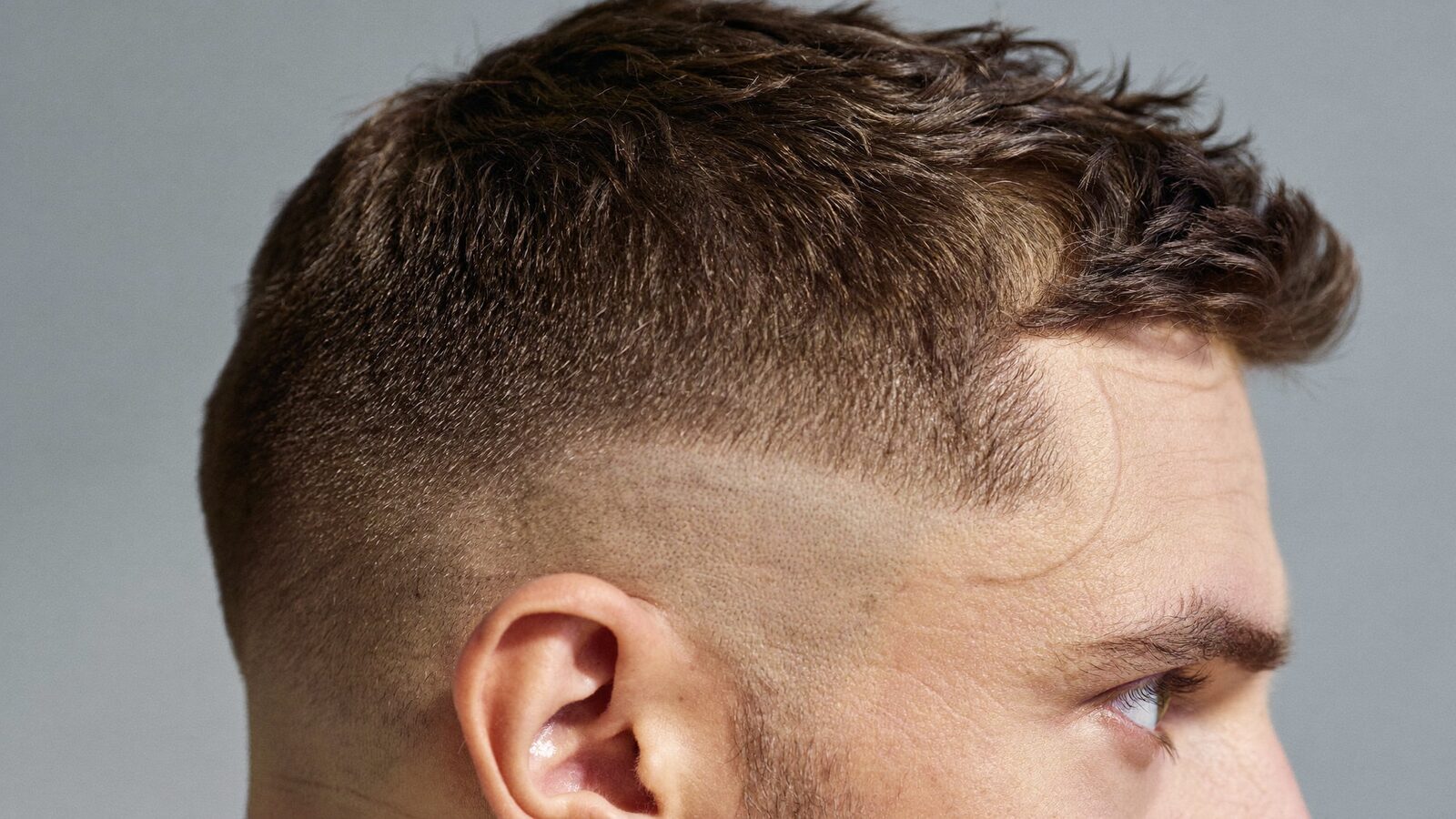
Temple point restoration is a small hair transplant that rebuilds the two pointed tufts of hair that sit just in front of each ear, below the outer corners of the hairline. Using FUE, roughly 150 to 400 single-hair grafts per side are placed at a very flat angle, which brings back the side frame of the face that thins out as temples recede.
This guide explains what those points do for your face, how the grafts are angled and spaced, typical graft numbers, and how the work differs for women. If you want the technique background first, our FUE hair transplant in Nashville page covers how follicles are harvested and placed.
Key takeaways
- Temple points are the triangular tufts of hair on each side of the head, between the receding temple corner and the sideburn.
- Most temple point restorations use roughly 150 to 400 grafts per side, almost all of them single-hair grafts.
- Temple hairs grow nearly flat against the skin and point down and slightly backward, so placement angle matters more here than almost anywhere else on the scalp.
- Temple work is usually combined with a frontal hairline plan rather than done alone, so the two areas connect naturally.
- New hair typically starts to show at 3 to 4 months, with the final look around 12 months.
What are temple points?
Temple points are the small, forward-pointing triangles of hair that project from the side hair toward the outer corner of each eye. They sit below the frontotemporal angle, the corner where the front hairline turns back toward the ear, and they connect the sideburns to the top of the head. Every full adult hairline has them.
Think of the hairline as a frame with three parts: the front edge across the forehead, the two temple corners above the outer brows, and the temple points lower down on the sides. A receding hairline usually starts at the corners. The temple points often hold on for years, then slowly blunt, retreat backward toward the ear, or thin until the skin shows through.
When the points erode, the side of the face loses its border. The cheekbone and the temple hollow merge into one long stretch of skin, and the head can look wider at the top and narrower near the jaw. That is why patients often say they look tired or older without being able to name the cause.
Common reasons temple points recede
- Male pattern hair loss: the same hormone sensitivity that drives a receding hairline can blunt the points over time.
- Traction: tight ponytails, braids, headbands or helmets that pull at the sides of the head over many years.
- Female pattern and hormonal shifts: pregnancy, menopause and thyroid changes can thin the side hairline in women.
- Age: even without patterned loss, temple hair tends to get finer and sparser in later decades.
Why do temple points matter so much for the face?
Temple points matter because they set the visual width of the upper face and draw a line between forehead and cheek. Restoring them shortens how long the face looks from the side, softens a gaunt or angular look, and makes a new front hairline appear finished instead of floating above bare sides.
A common scenario: a man has a well-planned frontal hairline transplant, but nobody addressed his sides. From the front the result looks good. From a three-quarter angle, the new hairline seems to start abruptly with nothing below it, and the overall effect looks like a hairpiece sitting on top of the head. Adding temple points closes that gap.
The points also carry information about age and gender. A sharp, slightly forward point reads as youthful and masculine. A softer, rounded side border with fine wisps reads as feminine. Getting this right is part of hairline design, which is why Dr. Dan Hatef reviews the side profile, not only the front, before approving any plan.
Tip: Look at an old photo of yourself in profile from your early twenties. The shape and position of your temple points back then is often the most useful reference for a natural restoration.
Graft angles and density in the temple zone
Temple point grafts are placed at a very low angle, often 10 to 20 degrees from the skin, and aimed downward and slightly back toward the ear. Each one is usually a single-hair graft. That flat, directional placement is the main difference between temple work and crown or mid-scalp work.
Hair on top of the head grows outward at a steeper angle, so a graft placed the same way on the temple would stick out like a spike. Temple hairs lie close to the skin and change direction gradually as you move from the sideburn up toward the corner. The recipient sites, the tiny openings that receive each graft, have to follow those small shifts one by one.
Density: lighter at the edge, fuller behind
Natural temple points are not dense at the tip. They start with a scatter of fine single hairs, then fill in toward the base where they join the side hair. A restoration copies that gradient. Packing grafts too tightly at the tip creates a hard edge that looks drawn on.
| Feature | Temple points | Frontal hairline | Crown |
| Typical graft type | Mostly single-hair | Single-hair edge, 2 to 3 hair behind | 2 to 3 hair grafts |
| Exit angle from skin | Very flat, about 10 to 20 degrees | Low to moderate | Steeper, following the whorl |
| Hair direction | Down and back toward the ear | Forward | Spiral around the center |
| Density pattern | Sparse tip, fuller base | Soft edge, denser behind | Even coverage |
| Typical grafts | 150 to 400 per side | Often 800 to 1,500 | Often 1,000 to 2,000 |
Because the hairs are so fine and so flat, the team works slowly here. At our Nashville clinic, grafts are extracted by hand with fine handheld FUE instruments, and Dr. Hatef designs the temple shape with the patient before any site is made. Dr. Hatef oversees the procedure so that the angle and direction stay consistent with the approved map.
How many grafts does temple point restoration take?
Temple point restoration usually takes roughly 150 to 400 grafts per side, or about 300 to 800 grafts for both sides. The number depends on how far the points have receded, how thick your hair is, and whether the temples are being restored alone or as part of a larger hairline plan.
Coarse or curly hair covers more skin per graft, so fewer grafts may give the look you want. Fine, straight hair needs more grafts for the same visual fullness.
- Mild blunting: the point is still present but rounded off. Often 150 to 250 grafts per side.
- Moderate retreat: the point has moved back toward the ear and thinned. Often 250 to 350 grafts per side.
- Near-complete loss: only a faint trace remains. Often 350 to 400 or more per side, usually combined with corner work.
Temple grafts come from the same donor area at the back and sides of the head as any other transplant. The clinic protects that donor supply and leaves a reserve for future loss, so if you are also planning frontal or crown work, the temple portion is budgeted in from the start. Our team can complete up to about 4,000 grafts in one day depending on donor density, so temples and hairline can often be done together. For a sense of what side-profile results look like, the before and after gallery includes several three-quarter views.
Is temple point restoration done on its own?
Temple point restoration is sometimes done on its own, but it is more often paired with work on the frontal hairline or temple corners. Restoring points under a heavily receded corner can look odd, so most plans treat the whole side frame as one design.
Standalone temple sessions make the most sense for people whose front hairline is still strong, for women with traction thinning at the sides, and for patients who had a frontal transplant years ago and now want to complete the frame. A small temple session usually takes a few hours under local anesthesia, and you go home the same day.
If you are still losing hair, medication or a separate PRP plan can help protect the native hair around the new grafts. Our guide on combining PRP with a hair transplant explains timing and who tends to benefit.
Temple point restoration for women
Women seek temple point restoration mainly for thinning at the sides from traction, hormonal change or aging, rather than classic recession. The goal is usually a softer, rounded side hairline with fine wisps, not the sharper forward point that suits many men.
Women also tend to want to keep their existing hair long, so the session may be planned to avoid shaving the whole head. Fine baby hairs at the edge are a big part of a feminine look, and single-hair grafts placed very flat recreate them well. If traction caused the loss, the hairstyle that caused it has to change, or the new hair may thin the same way.
Diffuse thinning that also affects the donor area can limit what a transplant can do. That is why every female case starts with a scalp exam. Our female hair transplant page explains how candidacy is assessed for women.
What does recovery look like after temple work?
Recovery after temple point restoration is usually quick: small scabs around the temples for about 7 to 10 days, mild swelling that can drift toward the eyes for a couple of days, then shedding of the transplanted hairs at 2 to 6 weeks before new growth starts.
- Week 1: sleep with your head raised, keep the area clean, avoid touching or rubbing the temples.
- Weeks 2 to 6: scabs are gone and the transplanted hairs often shed. This is normal and expected.
- Months 3 to 4: fine new hairs start to appear at the sides.
- Months 6 to 12: hairs thicken and the points take on their final shape.
Tennessee summers bring strong sun and plenty of sweat, which both bother healing skin. A loose, clean hat is fine after the first several days if your aftercare sheet allows it, but avoid tight caps that press on the temples.
Questions to ask at your consultation
A good temple consultation should leave you with a clear picture of where the new points will sit, how many grafts they will use, and how they fit your donor budget. Bringing a short list of questions helps you compare plans honestly.
- Where exactly will the points sit? Ask to see the outline drawn on your skin, from the front and in profile.
- How many grafts per side? And what share of them will be single-hair grafts.
- How does this affect future work? Ask how much donor reserve remains for later hairline or crown sessions.
- What if my hair loss continues? Ask how the plan holds up if the hair around the temples keeps thinning.
Questions about experimental options come up too. Hair cloning and stem cell treatments are still research and are not offered; our article on stem cells and hair cloning covers where that science stands today.
Want your temple points back?
Book a free assessment in Nashville. We will map your temples, count your donor grafts and give you a written plan.