
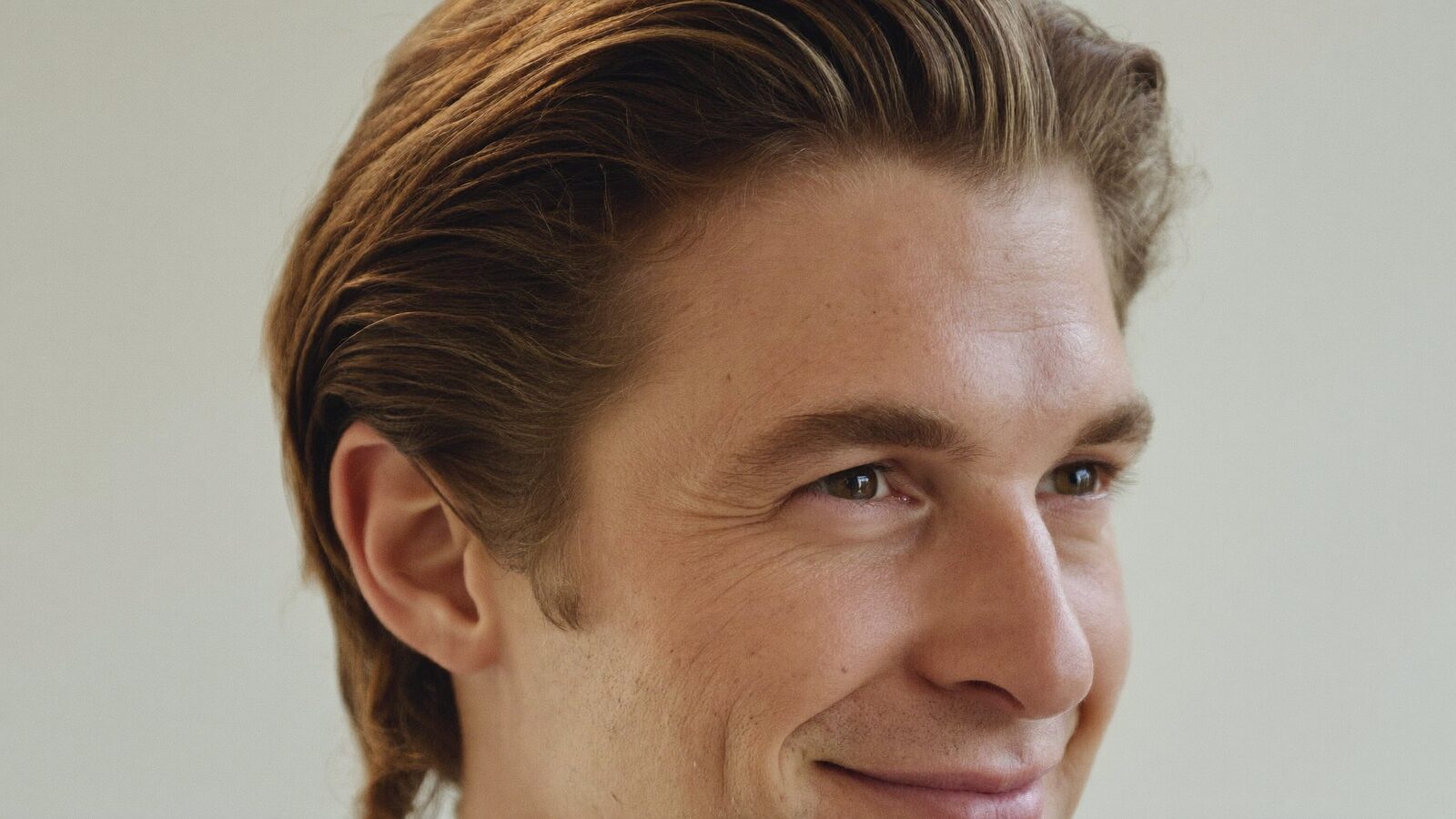
Natural hairline design comes down to three choices made before a single graft is placed: how high the hairline sits on the forehead, what shape it follows across the face, and how soft and irregular its front edge is. Get those right and the hairline reads as your own; get one wrong and even dense, healthy grafts can look placed rather than grown.
None of this is a fixed template. A hairline that suits a 25-year-old with an oval face can look out of place on a 50-year-old with a square jaw. At our Nashville clinic, the hairline for every FUE hair transplant is drawn on the scalp and agreed with the patient before the procedure starts. This guide explains the proportions, shapes and fine details that go into that drawing.
Key takeaways
- A natural hairline usually sits where the forehead makes up roughly one third of the face, measured from the brows to the hairline.
- Face shape guides the outline: rounder, softer curves for square faces and slightly more defined temple corners for round faces.
- The front few millimeters of a natural hairline are made of single-hair grafts set in an irregular, uneven pattern, never a straight row.
- A well-designed hairline is planned for how you will look in 15 to 20 years, not only next year, because hair loss behind it usually continues.
- Graft angle matters as much as position: hairline hairs should leave the scalp at a low, forward angle, not stand straight up.
Where should a hairline sit on the face?
A natural hairline usually sits where the face divides into three roughly equal parts: hairline to brows, brows to the base of the nose, and nose to chin. Placing the hairline at the top of that upper third keeps the forehead in proportion. For most adult men, that point lands several finger widths above the brows.
Facial thirds come from classical portrait drawing and remain a practical starting point. A hairline set too low shrinks the forehead and makes the whole face look compressed, which is a common sign that someone has had work done. A hairline set slightly high, by contrast, simply looks like a mature adult hairline.
The middle point at the front, often called the frontal tuft or the hairline apex, is the anchor for the rest of the design. From there the line runs back toward the temples. In most men, the adult hairline is not flat across: it rises at the corners into the frontotemporal angle, the recess between the front hairline and the temple hair. Leaving a gentle recess there is one of the details that separates a grown look from a wig-like one.
Quick self-check: Raise your eyebrows and look in the mirror. The highest forehead crease is a rough guide to where an adult hairline often sits. Designers do not copy that line exactly, but it is a useful reference point when you first talk about height.
Hairline shapes for oval, round and square faces
The right hairline shape depends on face shape because the hairline frames the upper face like the top of a picture frame. Oval faces suit most outlines, round faces benefit from slightly more defined temple corners, and square faces usually look softer with a rounded front edge that does not echo a strong jaw.
| Face shape | Typical design approach | What to avoid |
| Oval | Gentle curve with soft temple corners; most heights and shapes look balanced | Setting the line too low just because it is possible |
| Round | Slightly more angled temple recess and a modest central point to add vertical length | A fully rounded, low line that makes the face look wider |
| Square | Rounded front edge with softened corners to balance a strong jaw and brow | A flat, straight line that repeats the boxy outline of the jaw |
| Long or oblong | A hairline at the lower end of the natural range to shorten the face visually | A high, receded design that stretches the forehead further |
| Heart | Moderate height with a softly curved center to balance a wider forehead and narrow chin | Deep temple corners that exaggerate width at the top |
Face shape is only one input. Brow position, the slope of the forehead, the size of the nose and even how you wear your hair all influence the final outline. Someone who combs straight back needs a more finished front edge than someone who wears a fringe.
Women's hairlines follow different rules. Female hairlines are usually rounder and lower, with little or no temple recess and often a soft widow's peak. Men's designs that borrow those features can look feminine, while women's designs that borrow male corners can look receded, so the shape is always drawn for the individual.
Irregularity and single-hair grafts
Irregularity and single-hair grafts are what make the edge of a hairline look natural up close. A natural hairline is not a crisp line but a soft zone a few millimeters deep, where fine single hairs scatter unevenly in front of denser hair. Copying that zone is the most painstaking part of a transplant.
Every graft is a follicular unit, a natural bundle of one to four hairs. In a well-planned case, the grafts are sorted by size before placement:
- Single-hair grafts: Reserved for the first few rows of the hairline and the temple points, where softness matters most.
- Two-hair grafts: Placed just behind the front edge to build the transition from fine to full.
- Three- and four-hair grafts: Used further back, where density counts more than a delicate edge.
Within the front zone, grafts are placed in a deliberately broken pattern. Designers often talk about micro-irregularities, small zigzags and gaps along the edge, and macro-irregularities, gentle bumps and dips in the overall outline. Small isolated hairs set a little in front of the main line, sometimes called sentinel hairs, complete the effect. A perfectly even edge is one of the quickest giveaways.
Angle and direction matter just as much. At the hairline, hairs usually grow forward at a low angle to the scalp, often around 15 to 20 degrees, and gradually change direction toward the temples. The crown, by contrast, follows a whorl. Our Nova Medical FUE protocol describes how grafts are extracted by hand and kept in good condition so they can be placed at these fine angles. If you want to understand why handheld FUE is used rather than a device, the article on FUE myths and facts walks through the common misconceptions.
How do you design a hairline that still fits in 20 years?
A hairline that still fits in 20 years is set at a mature height, keeps some temple recess, and leaves enough donor hair in reserve to treat future loss behind it. Pattern hair loss usually continues with age, so the design has to suit the face you will have later, not only the one you have today.
The classic mistake is restoring the hairline someone had at 18. That juvenile line sits low and straight across, and it looks fine for a few years. Then the hair behind it keeps thinning, and the patient is left with a dense band of hair at the front and a widening gap behind, a pattern that is very hard to correct and draws the eye far more than natural recession.
Future planning involves several judgments made together:
- Predicting the pattern: Family history, current Norwood stage (the standard scale of male pattern loss) and the speed of recent change suggest where loss is heading.
- Budgeting the donor area: The back and sides of the scalp hold a limited number of grafts for a lifetime. Up to about 4,000 grafts can be placed in a single day at our clinic, depending on donor density, but a reserve is always protected.
- Supporting native hair: Medication or PRP can slow thinning behind the new hairline so the result stays connected.
- Staging when needed: Larger plans are split into two sessions, which lets the second session respond to how hair behind the first one has changed.
What makes a hairline look natural instead of transplanted?
A hairline looks natural instead of transplanted when its height suits the face, its edge is soft and irregular, its front rows use single hairs at low forward angles, and the density increases gradually from front to back. When those four details are right, people notice that you look well, not that you had surgery.
Density deserves its own mention. A natural hairline is lighter at the very front and fuller a centimeter or so behind it. Packing the front edge with large grafts creates the tufted, doll-hair look associated with older plug transplants. Building density in layers keeps the edge soft and puts the grafts where they create the most visible fullness.
| Detail | Looks natural | Looks transplanted |
| Height | In proportion with facial thirds, age-appropriate | Too low, shrinking the forehead |
| Edge | Soft, uneven, with scattered single hairs | Straight, crisp line like a ruler |
| Temples | Gentle recess at the corners | Corners filled in flat across |
| Angle | Hairs lie forward at a low angle | Hairs stand upright or point in mixed directions |
| Density | Lighter at the front, fuller behind | Heavy grafts packed right at the edge |
Our article on natural and obvious hair transplants looks at these mistakes in more depth, including how they are spotted and corrected.
How the hairline is drawn at our Nashville clinic
At Nova Medical Hair Transplant Tennessee, the hairline is drawn on your scalp with a surgical marker during planning and adjusted with you in front of a mirror until it looks right from the front, the side and above. Dr. Dan Hatef designs the hairline with each patient and reviews the plan before the procedure goes ahead.
The conversation usually covers how you wear your hair, photos of how your hairline looked before it changed, and what you want to see in the mirror. Sometimes a slightly higher line is wiser to protect the donor area. Either way, you see the drawing and agree to it before anything begins.
On the day itself, the procedure takes place under local anesthesia, and you go home the same day. The surgical team extracts grafts by hand with fine FUE instruments, and Dr. Hatef oversees the procedure. Where it helps, grafts can also be placed with an implanter pen in a DHI-style approach. Early growth starts showing at around three to four months, with the hairline maturing over roughly 12 months.
Questions to ask about your hairline design
The most useful questions about hairline design are the ones that reveal how a clinic plans for your face and your future. A careful answer should cover height, shape, the type of grafts used at the front edge and how much donor hair will remain for later years.
- Height: Where will my hairline sit, and why that height for my face and age?
- Shape: How much temple recess will you keep, and why?
- Front edge: How many rows of single-hair grafts are planned for the edge?
- Future loss: What happens if the hair behind the hairline keeps thinning?
- Evidence: Can I see results on patients with a similar face shape and hair type?
Real results are the clearest proof of design skill, so look closely at hairlines in our before and after gallery, and pay attention to the front edge and temples rather than overall fullness.
Plan a Hairline That Fits Your Face
Book a free consultation at our Nashville clinic. We will assess your donor area, sketch a hairline with you and give you a written graft estimate and quote.